Healthcare Revenue Cycle Management: Electronic Data Interchange (EDI) and ANSI Standards
$35.00 Add to Cart
 Format: E-course
Duration: 185
Instructors: Coral MED
Learning Credits: 0.3 CEUs
Accrediting Body: IACET
*This course was updated on Jun 30, 2026.
Description
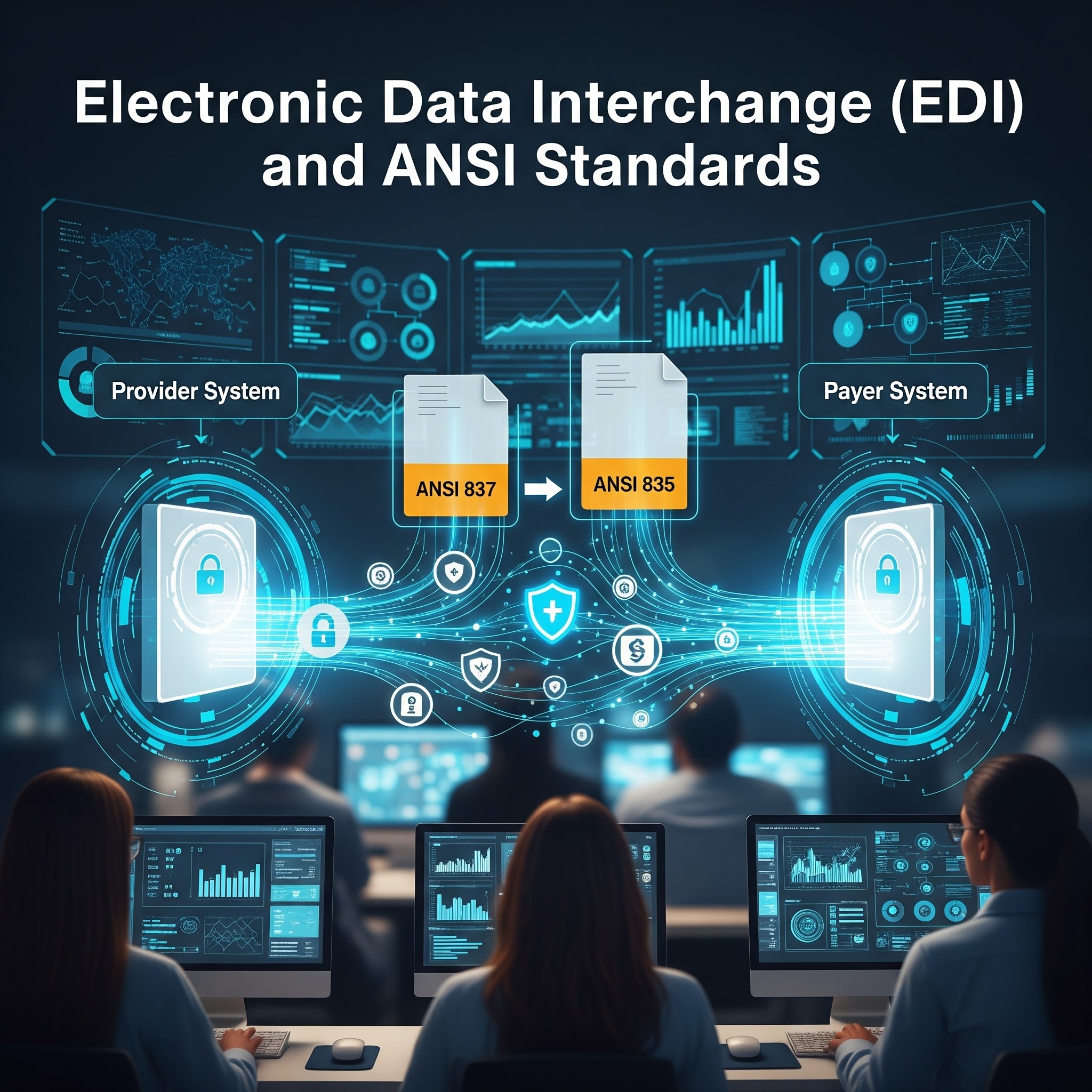
This unit explores Electronic Data Interchange (EDI) and its role in automating healthcare transactions between providers, clearinghouses, and payers. Learners will study the structure and purpose of ANSI X12 transaction sets, including 837 (claims), 835 (remittance advice), and 270/271 (eligibility). Students will gain hands-on understanding of how EDI facilitates secure data transmission, improves claims turnaround, and enhances operational efficiency. The unit also addresses error reporting, data integrity, and compliance considerations to ensure successful implementation of EDI in healthcare billing systems.
Define ANSI 837/835 and explain their use in EDI. Interpret ERA/EOB and remittance files. Demonstrate use of EDI tools for claims tracking. Evaluate common EDI errors and resolution steps. Analyze remittance data for payer trends. Develop a training module on EDI standards.
The learner will: Define the purpose and function of ANSI X12 standards in healthcare data exchange. Explain how 837, 835, and 270/271 transaction sets are used in claims, remittance, and eligibility verification. Demonstrate how to navigate and use EDI software tools to track claim transmissions and acknowledgments. Evaluate common EDI error codes, transmission failures, and corresponding correction steps. Analyze remittance advice data (835/ERA) to identify payer performance and reimbursement patterns. Develop a concise training module or workflow guide outlining EDI transaction processes and compliance requirements.
Before starting this unit, learners should have: Basic understanding of claim submission workflows and clearinghouse functions. Familiarity with payer data exchange requirements and billing software systems. Completion of Unit 4.1: Claims Submission and Clearinghouse Functions or equivalent EDI-related experience.
Follow Coral Plus LMS policies: participation, integrity, respectful conduct, HIPAA/privacy adherence, timely completion of assessments. 1. Participants should register in advance to receive access details. 2. Access links and passwords, if applicable, should be provided securely to registered participants. 3. Participants are encouraged to join the webinar a few minutes early to resolve any technical issues 4. Participants are responsible for ensuring a stable internet connection, compatible devices (computer, tablet, or smartphone), and recommended browsers. 5. A microphone and webcam may be required for interactive sessions. Please test your audio and video settings in advance. 6. The webinar may be recorded for educational purposes. 7. Recorded sessions may be shared with registered participants after the webinar. 8. Please be mindful not to share personal or confidential information during the webinar. 9. A detailed agenda will be provided, and each session will adhere to the schedule to cover all planned topics. 10. Time will be allocated for Q&A sessions and discussions. 11. A helpdesk or contact information for technical support will be provided during the webinar. 12. Common technical issues will be addressed at the beginning of the session. 13. Relevant resources, such as presentation slides or additional reading materials, will be shared after the webinar. Proprietary Interest Policy: It is the policy of Coral MED that if instructors have a vested interest in any product, instrument, device, or materials that may be used in the learning event, they must disclose this interest. Further, if the instructors receive any share of the royalties or profits from the product promotion or endorsement, the interest must be disclosed to the learner. If there are any breaches of this policy, please contact Coral MED at +1 (808) 913-7979 OR send an email to compliance@coralmed-inc.com Anti Discrimination Policy: Coral MED is committed to providing work and learning environments free of sexual or any form of unlawful harassment or discrimination. Harassment or unlawful discrimination against individuals on the basis of race, religion, creed, color, national origin, sex, sexual orientation, gender identity, age, ancestry, physical or mental disability, medical condition including medical characteristics, marital status or any other classification protected by local, state or federal laws is illegal and prohibited by Coral MED policy. If there are any breaches of this policy, please contact Coral MED at +1 (808) 913-7979 or send an email to compliance@coralmed-inc.com 6) Privacy & Data Protection Policy Coral MED values the privacy, security, and integrity of your learner records. Your information is managed in accordance with Policy CM012 – Learner Records Privacy and Data Security Policy, which complies with applicable data protection laws and accreditation standards.How to Request the Release or Correction of Your Records If you wish to obtain, release, or correct your learner records, please follow these steps: 1. Submit a written or electronic request to: elearn@coralmed-inc.com ↗ . 2. Include your full name, learner ID, and specific request type (e.g., transcript, name correction, verification letter). 3. Requests are processed within 10 business days of verification. 4. You will receive an email confirmation once your request has been fulfilled. Notification of Record Availability Upon completion of a learning event, Coral MED notifies learners via email when official records (e.g., transcripts, certificates, or CEUs) are issued or available for download within the LMS. You may review the full policy at any time by visiting:. View Policy ↗
This unit is ideal for professionals seeking to develop or advance skills in healthcare data exchange, automation, and compliance. It is especially beneficial for: EDI Analysts and Data Exchange Coordinators – managing transaction files and troubleshooting submission issues. Billing and Claims Specialists – working with electronic claim formats and payer remittance data. Revenue Cycle Managers – overseeing system interoperability and EDI compliance. Healthcare IT and Systems Analysts – integrating EDI tools with billing or EHR systems. Students and Entry-Level Professionals – building foundational knowledge in healthcare data standardization and automated claim processes.
Disclosure: The instructor(s) have disclosed no proprietary interests in any products, instruments, devices, or materials discussed in this course. Coral MED maintains full independence, objectivity, and scientific integrity in its educational activities

 View Details