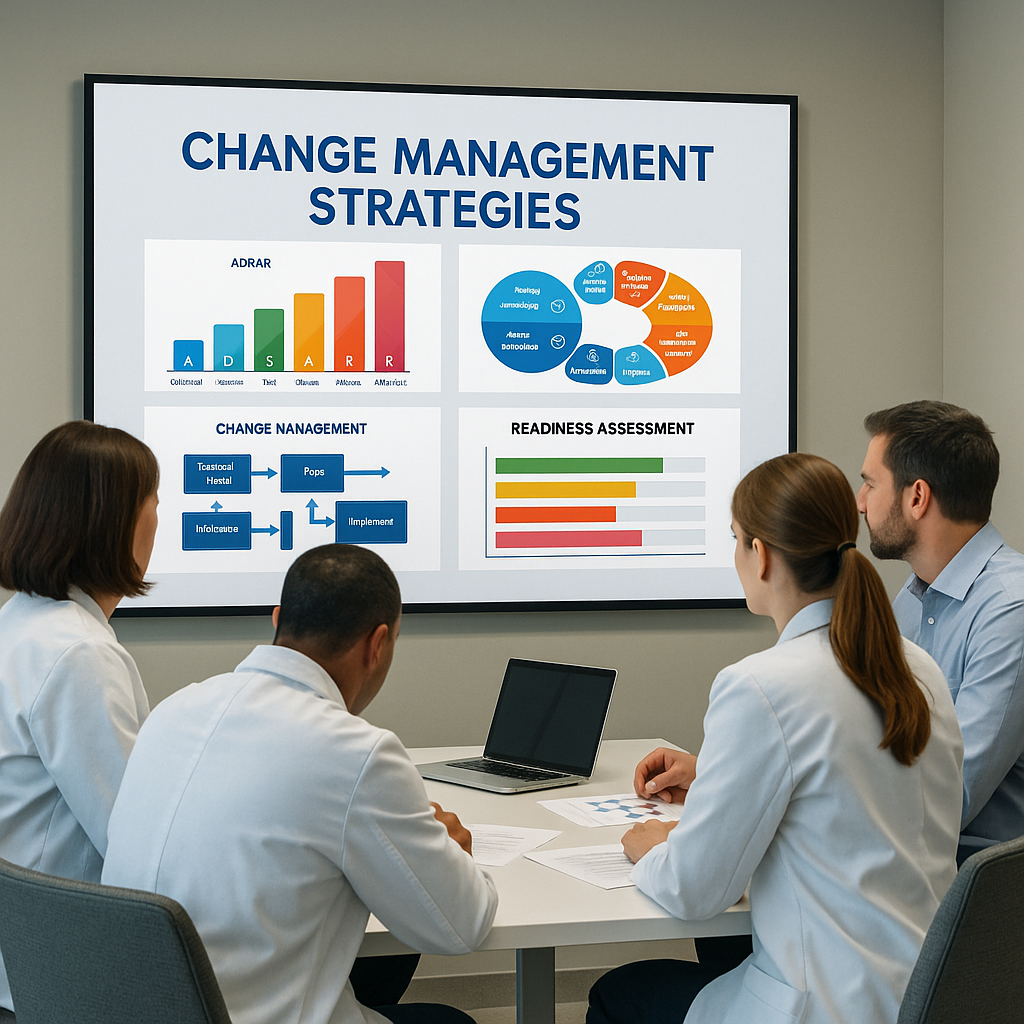
Healthcare Quality: Change Management Strategies
$35.00 Add to Cart
 Format: On demand
Duration: 180 MIns
Instructors: Coral MED
Learning Credits: 0.3 CEUs
Accrediting Body: Coral MED
*This course was updated on Jun 30, 2026.
Description
0.2
Discuss change management theories and their application in healthcare settings. Apply change management frameworks such as Lewin’s Model and Kotter’s 8-Step Model to implement quality improvement projects. Apply change initiatives in response to regulatory changes and quality improvement goals. Describe the psychological aspects of organizational change and manage resistance to change effectively. Relate change management strategies with performance metrics and regulatory requirements such as CMS and APMS. Evaluate the effectiveness of change management efforts in healthcare organizations. Design a change management plan to implement healthcare quality improvement initiatives
By the end of this course, learners will be able to: Describe change management theories and frameworks, including Lewin’s Model and Kotter’s 8-Step Model. Apply structured change management methodologies to healthcare quality improvement projects. Analyze regulatory and organizational drivers for change, including CMS and APMS requirements. Identify psychological and behavioral factors that influence resistance to change within healthcare teams. Evaluate the effectiveness of change initiatives using organizational performance and compliance metrics. Design a comprehensive change management plan that integrates communication, stakeholder engagement, and evaluation strategies. Implement change leadership practices that promote resilience, adaptability, and continuous improvement in healthcare organizations.
Prerequisites: Completion of Units 5.1 and 5.2 in this module. Familiarity with organizational dynamics, leadership principles, and performance measurement (Modules 3 and 4). Understanding of quality improvement tools (e.g., RCA, PDCA, Lean Six Sigma) and regulatory frameworks such as CMS and JCAHO. Rationale: Change management requires the ability to connect leadership theory with organizational systems and regulatory expectations. Learners benefit from prior experience in performance measurement and QI methodologies to apply structured change management frameworks effectively.
Follow Coral Plus LMS policies: participation, integrity, respectful conduct, HIPAA/privacy adherence, timely completion of assessments. 1. Participants should register in advance to receive access details. 2. Access links and passwords, if applicable, should be provided securely to registered participants. 3. Participants are encouraged to join the webinar a few minutes early to resolve any technical issues 4. Participants are responsible for ensuring a stable internet connection, compatible devices (computer, tablet, or smartphone), and recommended browsers. 5. A microphone and webcam may be required for interactive sessions. Please test your audio and video settings in advance. 6. The webinar may be recorded for educational purposes. 7. Recorded sessions may be shared with registered participants after the webinar. 8. Please be mindful not to share personal or confidential information during the webinar. 9. A detailed agenda will be provided, and each session will adhere to the schedule to cover all planned topics. 10. Time will be allocated for Q&A sessions and discussions. 11. A helpdesk or contact information for technical support will be provided during the webinar. 12. Common technical issues will be addressed at the beginning of the session. 13. Relevant resources, such as presentation slides or additional reading materials, will be shared after the webinar. Proprietary Interest Policy: It is the policy of Coral MED that if instructors have a vested interest in any product, instrument, device, or materials that may be used in the learning event, they must disclose this interest. Further, if the instructors receive any share of the royalties or profits from the product promotion or endorsement, the interest must be disclosed to the learner. If there are any breaches of this policy, please contact Coral MED at +1 (808) 913-7979 OR send an email to compliance@coralmed-inc.com Anti Discrimination Policy: Coral MED is committed to providing work and learning environments free of sexual or any form of unlawful harassment or discrimination. Harassment or unlawful discrimination against individuals on the basis of race, religion, creed, color, national origin, sex, sexual orientation, gender identity, age, ancestry, physical or mental disability, medical condition including medical characteristics, marital status or any other classification protected by local, state or federal laws is illegal and prohibited by Coral MED policy. If there are any breaches of this policy, please contact Coral MED at +1 (808) 913-7979 or send an email to compliance@coralmed-inc.com 6) Privacy & Data Protection Policy Coral MED values the privacy, security, and integrity of your learner records. Your information is managed in accordance with Policy CM012 – Learner Records Privacy and Data Security Policy, which complies with applicable data protection laws and accreditation standards.How to Request the Release or Correction of Your Records If you wish to obtain, release, or correct your learner records, please follow these steps: 1. Submit a written or electronic request to: elearn@coralmed-inc.com ↗ . 2. Include your full name, learner ID, and specific request type (e.g., transcript, name correction, verification letter). 3. Requests are processed within 10 business days of verification. 4. You will receive an email confirmation once your request has been fulfilled. Notification of Record Availability Upon completion of a learning event, Coral MED notifies learners via email when official records (e.g., transcripts, certificates, or CEUs) are issued or available for download within the LMS. You may review the full policy at any time by visiting:. View Policy ↗
This course is designed for professionals leading or supporting organizational transformation and improvement initiatives within healthcare systems. It is especially relevant to those tasked with managing resistance, fostering innovation, and implementing sustainable change. Healthcare executives and departmental leaders responsible for strategic transformation. Quality and performance improvement managers implementing process change initiatives. Policy makers and health administrators adapting to evolving regulatory and compliance requirements. Organizational development specialists and consultants facilitating large-scale healthcare changes. Healthcare educators or program managers designing change training and development initiatives. Learners gain practical skills in applying models such as Lewin’s Change Model and Kotter’s 8-Step Framework, preparing them for leadership roles in dynamic healthcare environments.
Disclosure: The instructor(s) have disclosed no proprietary interests in any products, instruments, devices, or materials discussed in this course. Coral MED maintains full independence, objectivity, and scientific integrity in its educational activities

 View Details